The Safety Gap

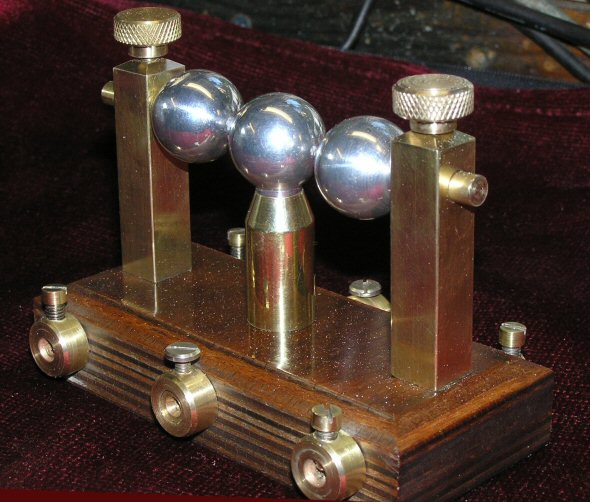
This important part gives protection to the transformer, be it a NST or to a lesser extent a PDT from any over-voltage situation that may occur, for example if the primary receives a strike from a streamer.
With NSTs it is also advised to have a Terry Filter as additional protection. The NST is one of the costlier and also fragile parts, so it is important to safeguard it.
The wiring is below, with the gaps adjusted so that they occasionally fire when running with everything else disconnected.
This ensures if the voltage climbs above normal they will then fire, shorting out the high voltage spike.
Obviously this shorts the NST output as well, but NSTs are built to withstand a short circuit across their output. This is because a neon tube initially presents a short circuit when it's first switched on.
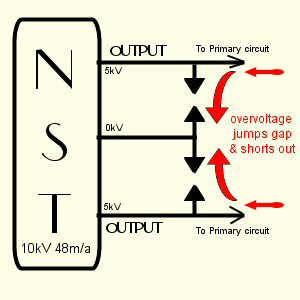
NSTs usually consist of two opposite wound coils with their ends joined to form a centre tapping. A 10,000 volt NST consisting of two 5,000 volt coils, a 15,000 volt one would be two 7,500 volt coils etc. This way the voltage across each coil is reduced, this in turn bringing down construction cost by way of lower insulation requirements.
As you can see in the main top picture I went overboard somewhat on the construction of this. Three spaced nails in a piece of wood would work just as well. I had recently purchased a knurling tool and a spherical turning attachment for my lathe, so this seemed like a good excuse to try them out.
If you have a Variac that is capable of giving out a slightly higher voltage than the input (most will) then a good way to adjust the safety gap is as follows. Set the Variac so its output voltage to the NST is the normal mains voltage that the NST is designed for. At this setting the safety gap should not be firing. Then increase the Variac's output voltage to the NST a little and the gap should now fire regularly. In the UK (235 volts ~ ) the NST steps up the voltage by a factor of 42 approx' for a 10Kv NST. So a 12 volt increase to the NST's primary winding will give nearly 500 volts of over-voltage on the secondary, so don't go too mad with the voltage control!
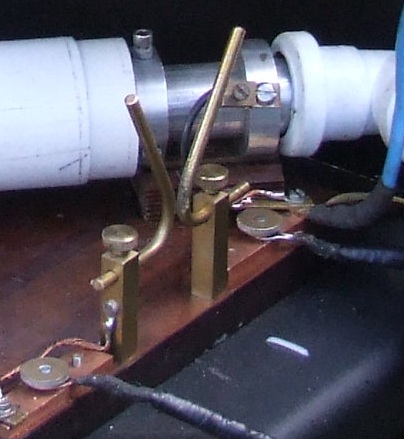
The safety gap shown at the top of the page is best suited to centre tapped transformers like NSTs. For my PDT or PIG I used a ordinary horn gap. This tends to act like a Jacob's ladder when it fires and thus extinguishes better.
As you can see in the main top picture I went overboard somewhat on the construction of this. Three spaced nails in a piece of wood would work just as well. I had recently purchased a knurling tool and a spherical turning attachment for my lathe, so this seemed like a good excuse to try them out.
If you have a Variac that is capable of giving out a slightly higher voltage than the input (most will) then a good way to adjust the safety gap is as follows. Set the Variac so its output voltage to the NST is the normal mains voltage that the NST is designed for. At this setting the safety gap should not be firing. Then increase the Variac's output voltage to the NST a little and the gap should now fire regularly. In the UK (235 volts ~ ) the NST steps up the voltage by a factor of 42 approx' for a 10Kv NST. So a 12 volt increase to the NST's primary winding will give nearly 500 volts of over-voltage on the secondary, so don't go too mad with the voltage control!
The safety gap shown at the top of the page is best suited to centre tapped transformers like NSTs. For my PDT or PIG I used a ordinary horn gap. This tends to act like a Jacob's ladder when it fires and thus extinguishes better.
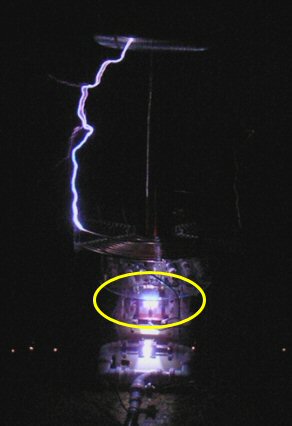
Here you can see the safety gap (circled in yellow) is firing as a result of a strike to Primary.
Underneath the safety gap you can also see the normal spark gap in operation as well. This was the original arrangement I had before I moved the spark gap to inside the base box (as can be seen Here).