Photos Page 1

Photos Page 2

You are Photos Page 3


Tesla Coil @ Cambridge 2009

Tesla photo3


Tesla photo3


There are 26 photos to load so please be patient.


The biggest problem I had when starting out was seeing other people's coils and ideas, and then deciding on the layout for my own coil. The very first Tesla coil that I saw 'in the flesh' was mine after I had built it.
Apart from YouTube videos and pictures on websites I had no idea what to expect. I saw websites with both good ideas and bad ones when it came to layout and advice.
The aim of this page is to give people ideas for their own coils by seeing someone else's. I am not saying mine is a good example because it isn't, but it may give you ideas and the mistakes I have made, you can then hopefully rectify. As I have a fairly small workshop and some serious issues with my spine when it comes to lifting and carrying, I had to make my coils not only portable but also to come apart easily.


Tesla Coil secondary hanging up

1: Hanging around waiting for the time it is needed. (Sorry for the pun)
As this is the most delicate part, hanging it up seemed the safest way to protect it from getting any damage.


Tesla Coil storage of primary

2: Primary is stored under the bench with the toroid.

The toroid, made from aluminium ventilation duct, is easily dented otherwise. Unfortunately the aluminium tape I covered it with tends to get burn marks where streamers have formed, so it has not proved too successful as a covering.


Tesla Coil main storage

3: The main part of the coil sitting in its 'kennel'.
The curtain drops down and all the dust is then kept out. Dust and high voltage can be a bad combination especially if the dust is conductive. And as my metal lathe is located four foot to the right, I have to be careful.


Tesla Coil NSTs in case

4: This old toolbox now houses the two 10,000 volt 50 mA NST's.
Originally the coil was designed and powered by a single NST which was housed in the box that is the base for the coil. Now that I use two NST's I need a separate box for them.


Tesla Coil NST plugs

5: The NST output plug's are simple 'banana' plugs that push into corresponding terminals on the Terry Filter, making a quick easy connection.

Easy connections are essential if your going to run the coil outside at night, as fiddley connections are a definite hindrance when you have cold hands!
All four earth leads (NST, Terry filter, Strike Ring, Base of secondary) simply bolt together with a wing nut onto the main RF earth cable.


Tesla Coil main storage

6: Ready to go.
The four uprights support the primary coil deck that just drops onto the posts. The MMC is a single sheet of 0.5 inch Acrylic. This is strong enough to take the secondary and toroid weight.


Tesla Coil NST connected

7: NST plugs (see 5 above ) are now plugged in and ready to go.
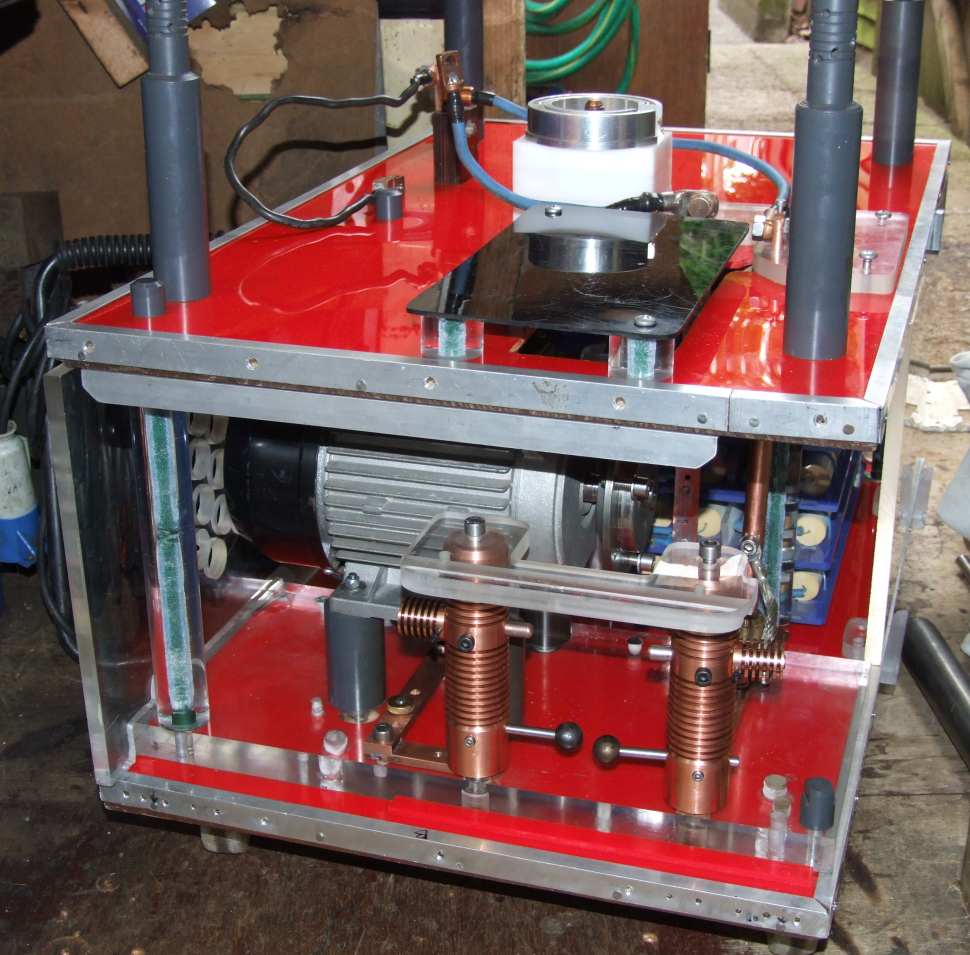
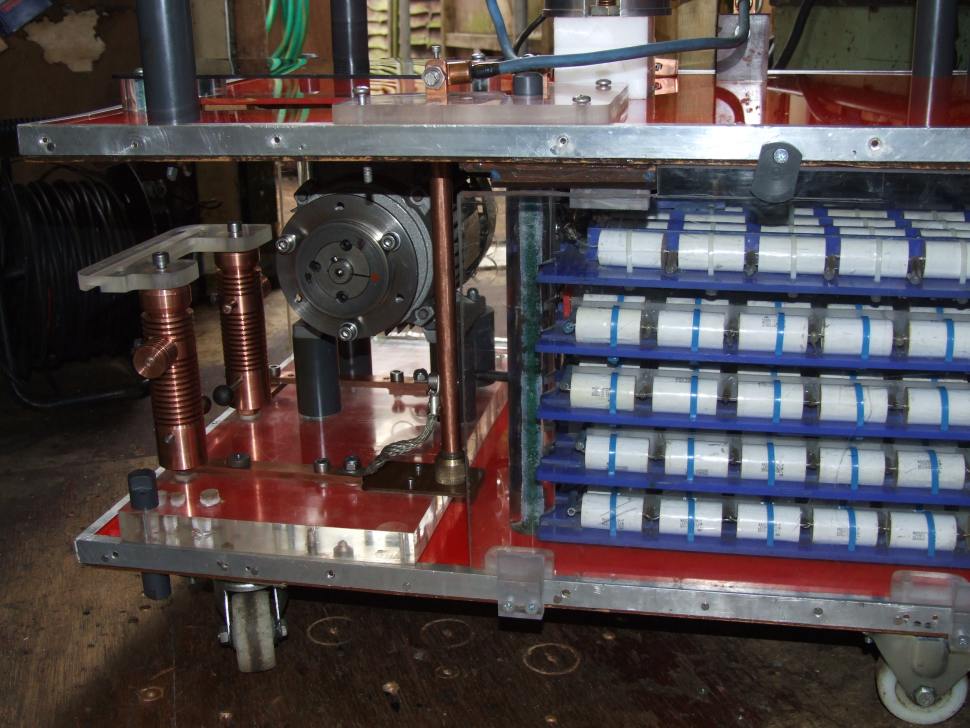
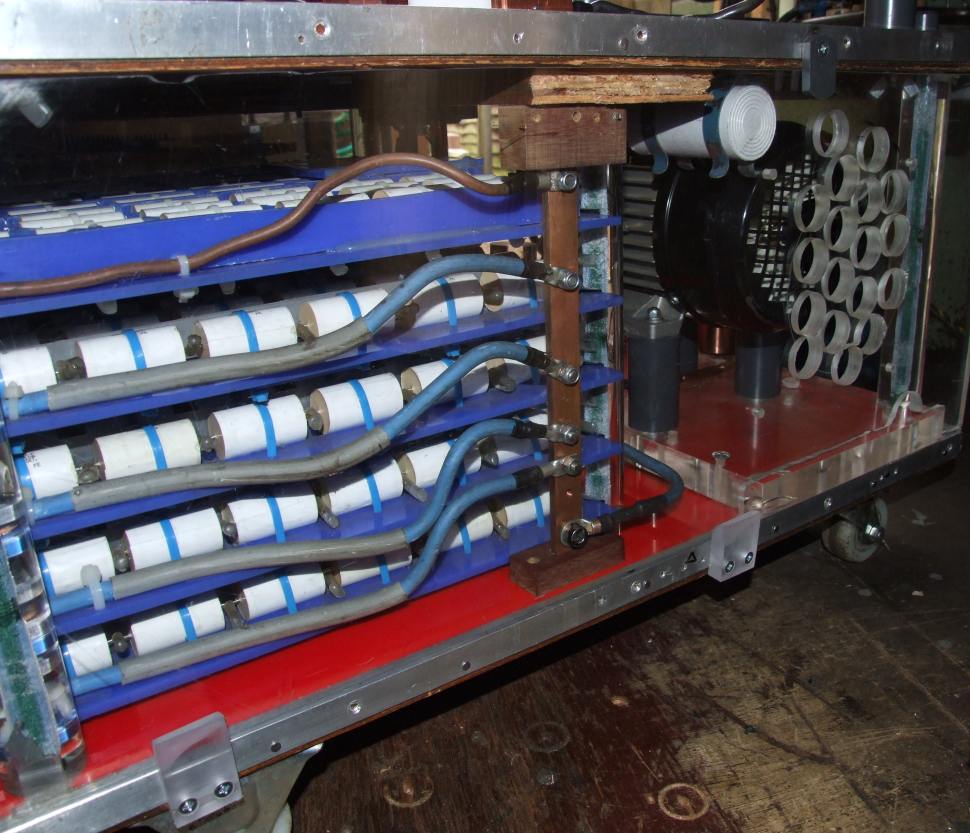
The thick blue lead goes from the capacitors down to the spark gap, which is located inside the box that forms the base.


Tesla Coil plugs close up

8: The two NST plug's connection into the Terry Filter.
These leads are not using correct high voltage wire at present, so they need to be kept apart. The current they carry is only 100mA, so this type of push-in connection is sufficient.


Tesla Coil ready for primary

9: Ready for the primary to be just dropped on.
The primary locates on the four plastic studs (circled in red) sticking up in the end of the acrylic rods. The secondary screws onto the central threaded stud (circled in blue).


Tesla Coil with primary

10: The primary just drops on.
In its base it has four holes that align with the locating studs mentioned above.


Tesla Coil primary mounting hole

11: Now the primary is in place you can just make out one of the locating studs (circled).
Next I just need to make two easy connections to finish the primary off.


Tesla Coil connection

12: Firstly the connection that goes to the inner coil of the primary.


Tesla Coil primary connection

13: This just tightens up by hand - nice and quickly using the large knurled nut.


Tesla Coil mounting post

14: Secondly, the circled mounting post is where the lead from the outer of the primary fastens onto.
This completes the connection onto one side of the MMC.


Tesla Coil mount

15: The lead (circled) is now in place.
Again I have used a knurled nut which is easily hand tightened, for ease of use.


Tesla Coil spark gaps

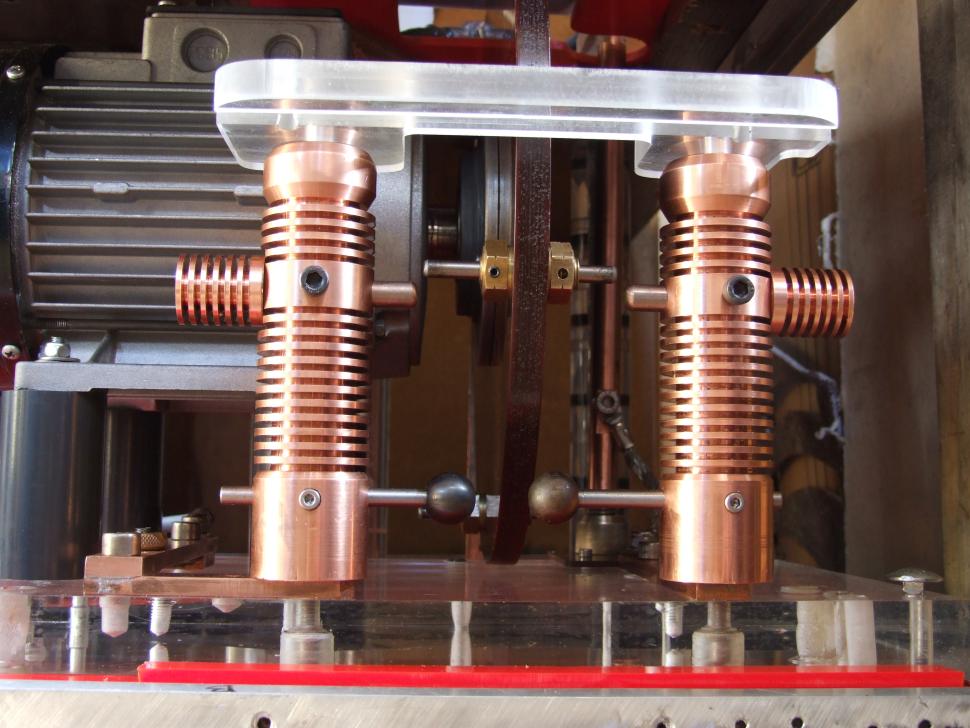
16: The main spark gap inside the base at the bottom.
This has an airtight cover and can be seen in more detail HERE.
This cuts down the spark gap noise significantly. Adequate air cooling takes care of the heat issue.


Tesla Coil tap

17: My first attempt at the outer (movable) clamp (tapping point) on the primary
To move the clamp a short distance you simply unscrew the bottom bolt a quarter turn, allowing the clamp to slide. This bottom bolt is also the connection for the other end of the lead shown above in 15.
To move into a different section (the primary's deck is split into 6 sections because of its mounting combs) you need to undo the two knurled top nuts and open the clamp up (see below).


Tesla Coil tap inside

18: Inside there was a little brass 'shoe' that made the contact.
This was free to move up and down in the surrounding acrylic, and was pushed hard against the tube by the bottom bolt.

Update: Although this made a very good contact, it proved too fiddley on a dark night with cold hands! For this reason I made the one shown below.


Tesla Coil assembled

19: The second attempt at a primary clamp.
The original one was just too fiddley on a dark night!


Tesla Coil hook

20: This short piece of studding screws into the base of the secondary allowing me to hang it up (see photo 1 above).


Tesla Coil

21: Once the studding (shown above in picture 20) is removed, the secondary then screws onto this mounting post.
This post can also be raised up and down to alter the primary to secondary coupling factor, by removing a brass pin and locating it in the different holes.


Tesla Coil secondary screwing on

22: The secondary is partially screwed on, and then is shown fully home.
The electrical connection to the RF earth is made through this mounting post as well.


Tesla Coil toroid

23: This half inch aluminium rod at the top end takes the toroid.
The toroid is a simple push fit.


Tesla Coil toroid hole

24: The underside of the ridged toroid showing the locating brass bush.
My smooth toroid, shown below, has the same mounting arrangement.


Tesla Coil assembled

25: The fully assembled 4.7 inch coil.

The two suction pipes for the sucker gap can be seen either side. Also the front cover is now in place. The black plastic thing in the front cover is the air inlet pipe. It is just a coincidence that it bears an uncanny resemblance to an old Hoover brush attachment.


Custom Search

Valid HTML 4.01 Transitional


   My Other Websites:

   master clocks icon

   fonthill abbey icon

flag

email

Valid HTML 4.01 Transitional


Site Last Updated 14th February 2010


Legal Nonsense © Copyright 'Tesla's legacy'