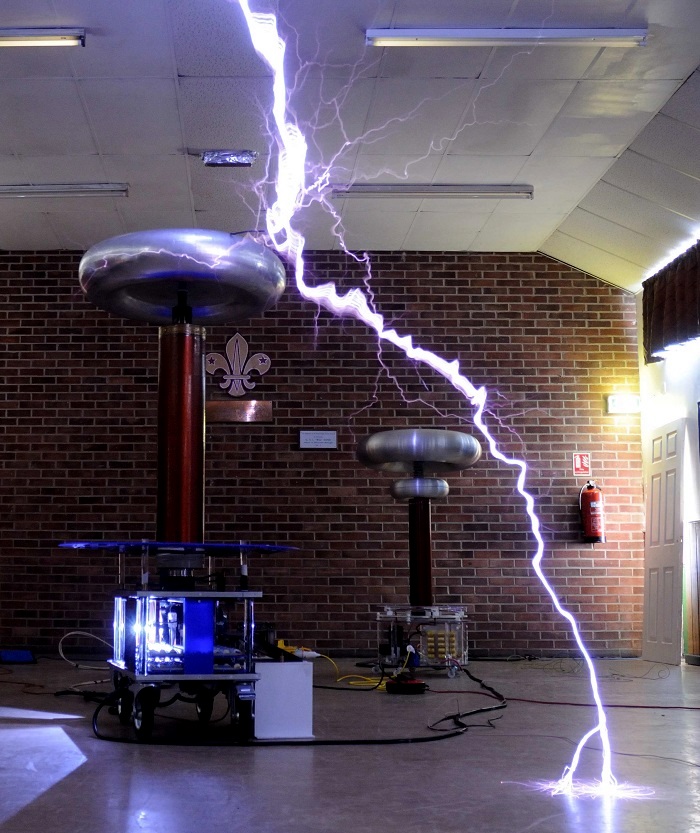
design a tesla coil


As these devices first appeared around 1891 there is no rocket science involved, but just care and forward planing which hopefully these notes may help you with.
These are the basic points about Tesla coil design that use conventional spark gaps, and that I have picked up and found useful.
There is of course a great deal more than this especially if you move onto the electronic side of coiling, although personally I will leave that to the clever ones.
Whatever path you take the best course of action is to join a newsgroup where you will find people who have years of empirical experience under their belt.

The basic points to consider:

Balance: Everything centres around getting a balance. Any one particular aspect of the design is either affected by something else, or it in turn will affect something else. So before you change one thing, think about what else it will affect.

Software: Programs like those found Here and (my favourite) JavaTC help enormously.

Research: For a complete novice the web is a mine of information. But remember these things can seriously harm you, so bearing that in mind don't take one single website as your guide. Viewing various sources lets you see what advice is correct, what is wrong, and what is just plain dangerous.

Location: Consider where you going to run the coil before you build it, so you can size it accordingly. The bigger the coil (in output power and therefore in physical size) the bigger the space that is required to run it. My 8 inch diameter coil is too big to run indoors, so it has to be in the garden, not the warmest of places in the UK winter, nor in the summer sometimes either.

Transportation: Unless you can roll the coil out into the garden complete, you may have to design it to breakdown and re-assemble easily. Big coils can get surprisingly heavy when the whole thing is assembled! I can only assemble and run the coil if someone does it for me because of health issues, so in my case it had to come apart easily. But making them so they dismantle is an excellent idea for everyone.

Cost: The cost for virtually every component goes up significantly with the size of the coil that you are building. Double the size of the coil and cost might rise threefold or more! So fully plan it out with software and price everything up. I know it is boring but its worth it in the long run.

Components: The HV power source, NSTOBITMOTPIG etc, and the secondary coil diameter size are totally inter-dependant to one another.

Capacitor: The total capacitance value needed is also linked to the HV power source mentioned above. The capacitor size chosen needs to be capable of being recharged within milli seconds, so bigger capacitance values demand higher wattage supplies.
If using an NST avoid having a capacitance value that is in resonance with the transformer's inductance. NST's, unlike other power sources, can be rather fragile and will not handle a high resonant rise in voltage. (Don't confuse resonance here with resonance between the primary and secondary coils of the tesla coil itself.) If though you are using a more robust 'PIG' as your power supply, resonance can be used to your advantage however.
Resonance:The AC equivalent of 'resistance' is reactance. So if the reactance of the inductor matches the reactance of the capacitor, the two will cancel one another out. This is called resonance and with very little resistance left in the circuit, apart from the wires themselves and the internal resistance of the power supply, it will mean the voltages across the capacitor can soar. This in turn will damage the NST and eventually the capacitor itself.

NST: NST's in the UK and Europe have a maximum voltage of 10,000 volts, or 15,000 volts in the USA. As mentioned above, avoid a resonant cap value when using these.

Power: NST's and OBIT's etc can be run in parallel to double the current and thereby also doubling the power. Multiple NST's however cannot be run in series to double the voltage though. Just isolating the cases is not enough, it is more complex than that.

Secondary Diameter: A good guide for low power coils below 500 Watts would be a 2 inch to 3 inch diameter. While 500 to 1000 Watts would be 3 to 4 inches, 1000 to 1500 Watts is 5 to 6 inches, over 1500 Watts and your looking at 8, 10, 12 inches or more!

Aspect ratio: This relates to the diameter versus the height of the winding of the secondary coil. This must be within certain limits which are mainly dependant on the power available. If the height is not enough then you will get too many damaging streamer strikes down to the primary. If it is too high the coil will be inefficient.
The aspect ratio for low to medium power coils (1 kw and less) is around 5:1, otherwise 4 to 4.5:1 seems to be popular. As an example a 5 inch coil at 1200 Watts would have a winding that is 20 inches tall. As the former (on which the coil is wound) will need around 2 inches left unused at each end, the whole thing will end up ~24 inches.
These figures are open to some variation.

Secondary Turns: Generally nowadays people aim for around 1200 / 1400 turns or even up to 1600 turns for smaller power coils. In the past the 'golden' figure people aimed for was 900 to 1000 turns, and even today there is more debate over this aspect than any other topic in tesla coiling.
It's important to remember though that these are not like conventional transformers where the number of turns affects the output voltage.
However it is not only the number of turns that are important but also the diameter of the winding wire your using. This is because there is another factor you may need to consider as well, and that is the windings inductance value. Fortunately it normally works out right by itself as explained below.

Coupling Coefficient: The number of cycles needed to exchange energy between the primary and secondary depends on the physical proximity or coupling coefficient(k) between the two windings. A low coupling means not only more cycles, and consequently more losses in the spark gap, but also the tuning can become more difficult. A too high a coupling however will give the problem of racing sparks** and especially if the spark gap is a static, it will have a harder task in quenching. Getting it right is by trial and error.
Normally the bottom of the ACTUAL secondary winding (not the coil former) would be within half an inch or so of the horizontal plane of the primary.

**Racing sparks are where the secondary coil has surface sparks rushing up and down its surface.


design method


The best component to get first is always the HV power source (NSTOBITMOTPIG) so you will then know the power that you have available to plan your design with. The HV power figure is very important because it not only dictates the diameter of the coil that you can build, but it may affect the amount of capacitance used in the primary circuit.

Once you know the power you will know the diameter you're using and you can decide on a suitable aspect ratio, which in turn allows you to work out the coils height. Next having decided on the number of turns needed (see above) you grab your calculator. By trying different gauges of wire, try to find a combination that gives you all the requirements your looking for (number of turns, within the height and diameter constraints that the aspect ratio allows).
You will normally find that the inductance value of your secondary design will work out satisfactory and you need not concern yourself with it at this stage. (JAVATC estimates this value if you really need to know)

Once you know all your secondary specifications you can next decide on a size for your 'top load' or Toroid. Its minor diameter will normally be similar to the secondary diameter, while the toroid's major diameter will be a bit less than the height of the secondary winding. All this then allows you to work out the resonant frequency of the secondary.
A very good guide explaining the whole design procedure can be found at the Deep Fried Neon website. Using the site above or using free design software like JAVATC is undoubtedly the best way of seeing how one component affects another.

As already mentioned, knowing the HV power source specifications (voltages and current) allows you to choose a suitable primary capacitance value. Small coils will use 10 to 20 nano farad (nF) up to very large 10-15KW coils needing up to 150nF. A bigger cap means more energy discharged into the secondary, but you MUST have sufficient power from your transformer source to fully recharge the cap in the short (milli secs) time period available.

The next stage is to work out the number of primary turns you require. The aim is that the inductance of the primary combined with the value of the capacitor will give you a resonant frequency figure that matches the frequency of the secondary inductance combined with the capacitance value of the Toroid.
It is best to try to aim for around 12 to 14 turns to be available(allows for adjustment) on the primary and aim to have your tap at around 10 turns.

Getting the primary coil's geometry correct so you can tap it at 10 turns (or whatever) is best done using the JavaTC program. The inner diameter coil of the primary wants at least an inch clearance around the secondary coil's diameter. So a 6 inch diameter secondary coil will have a primary with its inner coil at around 8 inches diameter. Most people use 0.25 or 0.375 diameter inch copper tubing.
The spacing between each turn in the coil should be at least the diameter of the tubing used. This stops 'flashover' between turns but also allows room for a clamp onto the tube to make your 'tapping point'.


Provided you follow these guidelines for the primary sizing you should find it gives a reasonable inductance value. Too low an inductance will result in excessive current flowing in the primary circuit and consequently bigger losses occurring in the spark gap. But too high a value will give you weak looking purple sparks that lack power. I explain more about this below.

If you don't balance things correctly, and no one ever does from the start (personal experience), the coil will still run, but the performance will be below that possible from a well designed coil, and it may even damage some of your components.

The Very Basic Tesla Circuit Diagram

Circuit diagram of a normal Tesla Coil


Although I have not shown one, you should really include an RFI filter in the incoming power line. In Tesla coil use they are protecting the incoming power, or house mains circuit, from any interference that the coil is sending back.
Normally the filters are labelled 'In' and 'Out' or 'Line' and 'Equipment' or something similar, but when using them in a Tesla situation it is generally considered that you now need to connect them in reverse. In other words the side that was designed to connect to the incoming mains feed, now needs to connect to the coil instead. This is because your protecting the mains from the Tesla interference.

However some people say this is incorrect, see here for a well respected and experienced coiler's views.
Tesla coils nowadays have very little real use in main stream science so any building and research is nearly all done by amateurs. The result is that some issues are ongoing and yet to be resolved. A good example was the size of the capacitor needed. At one time it was always considered desirable to use a value that was resonant with the HV supply. This is now recognised to be bad practice with NST's for the reason mentioned above.
The important thing to remember is try to stay within the now widely accepted, and empirically tested norm to start with.


choosing the capacitor value


As I have mentioned the actual value of the capacitance bank is dictated by the HV source you are using. All transformers will have an 'ideal' (or resonant) capacitance value that they would prefer to charge up. When this resonant condition occurs the transformer's reactance equals the reactance of the capacitance, and one cancels out the other. When this happens the voltage can be at a maximum, while the circuits impedance (AC resistance) is at a minimum. The result is that a very high voltage can quickly form that may damage the transformer.


mmc graph


Static Gap Capacitor

This is a simulation (PSpice) of my pig and the 61.3mH primary ballast it is using in conjunction with my 64.1nF capacitor on a static blown gap. The 61.3mH value on the primary x the turns ratio squared = 130.8H which is the inductance value on the secondary side that the capacitor 'sees', and resonates with.

This value of ballast and capacitance gave me a resonant frequency of 55Hz, which is uncomfortably close to the UK mains frequency of 50Hz. If the two resonant values had not been so close, the capacitor might expect to reach 36Kv approx'. However now my capacitor will see a possible voltage (this is a simulation - not the real world!) of 94Kv.

Static gaps will work with any size capacitance within reason, but SRSg's require specific values of capacitance and ballast to complement one another if you wish to get the max amount of power throughput.
This was all new to me until visiting Richie's site, so his page here is well worth a visit.
In fact if you wish to fully optimise your system, his is the website to visit.

200 bps SRSG Capacitor

With my 200bps SRSG the capacitance value I was using was 72nF, so I then did further Spice simulations to find the best value for that particular ballast when used on a 200bps rotary. (The breakrate of the rotary will affect things considerably)
A smaller value ballast will normally cause more current to flow, but when used with a SRSG that does not necessarily mean more power will flow.
The best option would be to aim for resonant charging using Richie Burnett's method. This however would have needed around 107nF which would prove too costly if I aim to also have a reasonably safe working voltage to the MMC as well - important when using resonant charging!

Hence I undertook some basic (simple) PSpice simulations using templates I downloaded from Richie's site, to find the best size of ballast to work with my 72nF @ 200 bps.

Below are the results using a range of differing ballast values.


tesla ballast graph


You can clearly see that with a 200bps SRSG, 60H to 62H of ballast gives the best power throughput when used with a 72nF capacitor. This ballast figure would change if either or both the bps rate or the capacitance value change. The best frequency for a resonant charging circuit to operate at is 60Hz when used with a 200bps rotary on a 50Hz supply, as explained in detail on Richie's site, but it would require to large a capacitor for the present time. (As a point of interest a 62H ballast (as the graph recommends) combined with my 72nF capacitance gives a charging frequency of 76Hz)


Generally in Tesla coil design you strive to get resonance in the primary and secondary circuits, but you need to be careful if you have resonance in the charging circuit when using a NST. These can be rather fragile to overvoltage and resonance has resulted in a lot of damaged NST's in the past. Modern NST's are also resin filled and consequently non-repairable.


This is the only time that you may want to avoid resonance in a Tesla coil.


The formula for this resonant value is 1/ (2 pi) x (impedance of transformer) x (line frequency) The transformer's impedance can be taken as being the Output Voltage / Output Current (don't try to measure it, just use the transformers specifications).

The value you choose then is either going to be a Larger Than the Resonant value, abbreviated to LTR, or a Smaller Than Resonance, STR. Generally if you are using a NST as your HV source you would aim for a LTR figure that is 1.5 to 2 times the resonant value. Using a pole distribution transformer (PIG) you would normally go the other way and choose a smaller than resonance, or STR value.

When I used two identical NST's running in parallel giving 100 m/A, the resonant value worked out to 31.8 nF. Instead of using a 1.5 to 2 times resonant value I chose to use 42nF which is 1.34 times the resonant value. This was a bit low , but it gave me a higher BPS on a static gap which is also an advantage.


Designing my 8 inch coil

The the Sec Voltage = Pri Volts * sqrt(L sec/L pri) or Sec Voltage= Pri Volts * sqrt ( C pri/C sec)

I therefore decided that with my latest coil I wanted a high secondary inductance (but the secondary capacitance shouldn't be too high) and a low primary inductance combined with a large primary capacitance. Unfortunately the low primary inductance causes more current in the primary circuit, so more spark gap losses, and a lot of coils are designed to optimise things to avoid this.  Taking some advice from another UK coiler though I decided to take a chance with the losses and it seems to have paid off.

The JavaTC output file of my 8 inch:
J A V A T C version 12.2 - CONSOLIDATED OUTPUT
23 November 2010 02:25:49

Units = Inches
Ambient Temp = 68F

----------------------------------------------------
Surrounding Inputs:
----------------------------------------------------
50 = Ground Plane Radius
50 = Wall Radius
100 = Ceiling Height

----------------------------------------------------
Secondary Coil Inputs:
----------------------------------------------------
Current Profile = G.PROFILE_LOADED
3.9365 = Radius 1
3.9365 = Radius 2
27.203 = Height 1
61.612 = Height 2
1398 = Turns
0.0220471 = Wire Diameter

----------------------------------------------------
Primary Coil Inputs:
----------------------------------------------------
5.2165 = Radius 1
11.51 = Radius 2
26.77 = Height 1
26.77 = Height 2
10.5 = Turns
0.32 = Wire Diameter
0.0722 = Primary Cap (uF)
24 = Total Lead Length
0.2 = Lead Diameter

----------------------------------------------------
Top Load Inputs:
----------------------------------------------------
Toroid #1: minor=6.102, major=27.952, height=69.9589, topload

----------------------------------------------------
Secondary Outputs:
----------------------------------------------------
86.46 kHz = Secondary Resonant Frequency
90 deg = Angle of Secondary
34.41 inch = Length of Winding
40.6 inch = Turns Per Unit
0.00257 inch = Space Between Turns (edge to edge)
2881.5 ft = Length of Wire
4.37:1 = H/D Aspect Ratio
60.9771 Ohms = DC Resistance
42250 Ohms = Reactance at Resonance
4.24 lbs = Weight of Wire
77.774 mH = Les-Effective Series Inductance
82.258 mH = Lee-Equivalent Energy Inductance
80.871 mH = Ldc-Low Frequency Inductance
43.569 pF = Ces-Effective Shunt Capacitance
41.194 pF = Cee-Equivalent Energy Capacitance
65.433 pF = Cdc-Low Frequency Capacitance
9.93 mils = Skin Depth
33.07 pF = Topload Effective Capacitance
136.6703 Ohms = Effective AC Resistance
309 = Q

----------------------------------------------------
Primary Outputs:
----------------------------------------------------
79.02 kHz = Primary Resonant Frequency
8.61 % high = Percent Detuned
0 deg = Angle of Primary
45.98 ft = Length of Wire
4.66 mOhms = DC Resistance
0.279 inch = Average spacing between turns (edge to edge)
1.18 inch = Proximity between coils
1.23 inch = Recommended minimum proximity between coils
55.529 μH = Ldc-Low Frequency Inductance
0.0603 μF = Cap size needed with Primary L (reference)
0.662 μH = Lead Length Inductance
299.567 μH = Lm-Mutual Inductance
0.141 k = Coupling Coefficient
0.141 k = Recommended Coupling Coefficient
7.09 = Number of half cycles for energy transfer at K
44.32 μs = Time for total energy transfer (ideal quench time)

----------------------------------------------------
Transformer Inputs:
----------------------------------------------------
250 [volts] = Transformer Rated Input Voltage
11550 [volts] = Transformer Rated Output Voltage
405 [mA] = Transformer Rated Output Current
50 [Hz] = Mains Frequency
263 [volts] = Transformer Applied Voltage
0 [amps] = Transformer Ballast Current
0 [ohms] = Measured Primary Resistance
403 [ohms] = Measured Secondary Resistance

----------------------------------------------------
Transformer Outputs:
----------------------------------------------------
4678 [volt*amps] = Rated Transformer VA
28519 [ohms] = Transformer Impedence
12150.6 [rms volts] = Effective Output Voltage
19.68 [rms amps] = Effective Transformer Primary Current
0.4261 [rms amps] = Effective Transformer Secondary Current
5177 [volt*amps] = Effective Input VA
0.1116 [uF] = Resonant Cap Size
0.1674 [uF] = Static gap LTR Cap Size
0.291 [uF] = SRSG LTR Cap Size
238 [uF] = Power Factor Cap Size
17184 [peak volts] = Voltage Across Cap
42959 [peak volts] = Recommended Cap Voltage Rating
10.66 [joules] = Primary Cap Energy
619.6 [peak amps] = Primary Instantaneous Current
104 [inch] = Spark Length (JF equation using Resonance Research Corp. factors)
15.2 [peak amps] = Sec Base Current

----------------------------------------------------
Rotary Spark Gap Inputs:
----------------------------------------------------
1 = Number of Stationary Gaps
4 = Number of Rotating Electrodes
3000 [rpm] = Disc RPM
0.25 = Rotating Electrode Diameter
0.25 = Stationary Electrode Diameter
9 = Rotating Path Diameter

----------------------------------------------------
Rotary Spark Gap Outputs:
----------------------------------------------------
4 = Presentations Per Revolution
200 [BPS] = Breaks Per Second
80.3 [mph] = Rotational Speed
5 [ms] = RSG Firing Rate
10.295 [ms] = Time for Capacitor to Fully Charge
2.43 = Time Constant at Gap Conduction
353.68 [μs] = Electrode Mechanical Dwell Time
91.18 [%] = Percent Cp Charged When Gap Fires
15669 [peak volts] = Effective Cap Voltage
8.86 [joules] = Effective Cap Energy
655968 [peak volts] = Terminal Voltage
1773 [power] = Energy Across Gap
107.4 [inch] = RSG Spark Length (using energy equation)

----------------------------------------------------
Static Spark Gap Inputs:
----------------------------------------------------
2 = Number of Electrodes
0.75 [inch] = Electrode Diameter
0.22 [inch] = Total Gap Spacing

----------------------------------------------------
Static Spark Gap Outputs:
----------------------------------------------------
0.22 [inch] = Gap Spacing Between Each Electrode
17184 [peak volts] = Charging Voltage
16378 [peak volts] = Arc Voltage
35390 [volts] = Voltage Gradient at Electrode
74447 [volts/inch] = Arc Voltage per unit
95.3 [%] = Percent Cp Charged When Gap Fires
3.271 [ms] = Time To Arc Voltage
306 [BPS] = Breaks Per Second
9.68 [joules] = Effective Cap Energy
685676 [peak volts] = Terminal Voltage
2960 [power] = Energy Across Gap
117.8 [inch] = Static Gap Spark Length (using energy equation)


Custom Search

Valid HTML 4.01 Transitional


   My Other Websites:

   master clocks icon

   fonthill abbey icon

flag

email

Valid HTML 4.01 Transitional


Site Last Updated 14th February 2010


Legal Nonsense © Copyright 'Tesla's legacy'