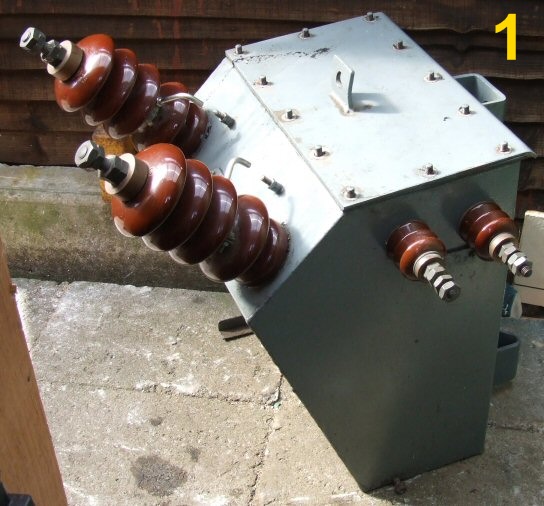
Above: The PDT as it was when we acquired it.
We had just finished making my own
HV transformer when I saw this Pole Distribution Transformer (PDT) for sale. Unable to resist it and with no thought given as to how heavy these things are, I decided to buy it. After completing a 435 mile round trip to collect it, with thankfully someone lifting it in for me, We decided to test it by running a Jacob's ladder. Using the 250 volt : 11550v taps I fed in 263 volts which gave 12kV out.
As these units are built to a high specification for continuous running in all temperatures, I decided to ballast the transformer for 500 m/a at 12kV giving 6kVA (original specification was 5kVA continuous) The secondary current is therefore slightly overloaded from the manufacturers continuous run' specification of 454 m/a.
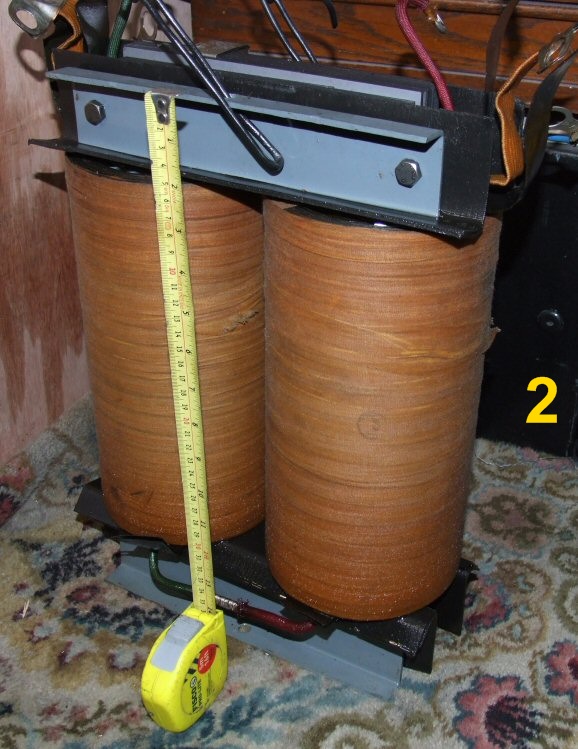
Above: The total height is 16 inches. Weight of cores is 90 Pounds
The two secondaries are each wound over their respective primary winding. I am unable to ascertain the number of turns or the gauges of the wires that have been used.
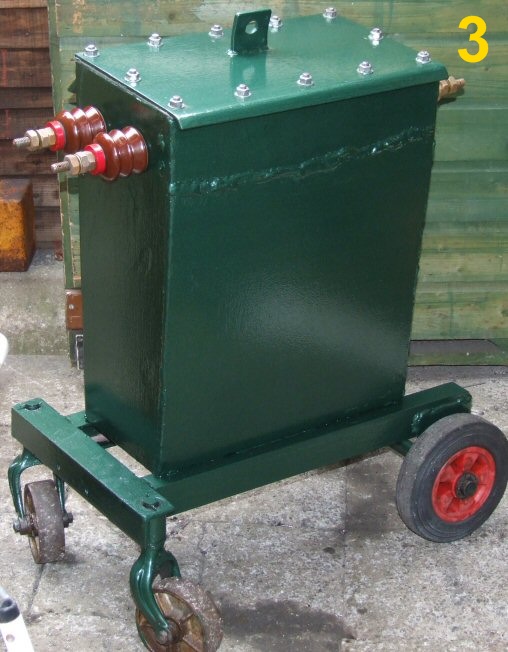
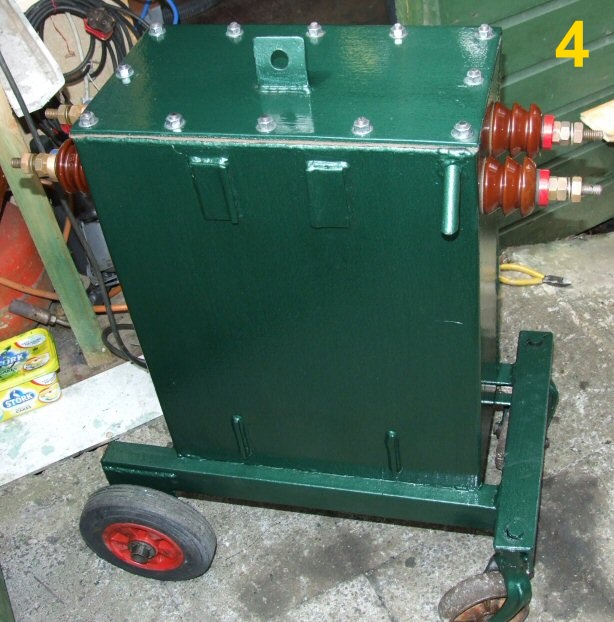
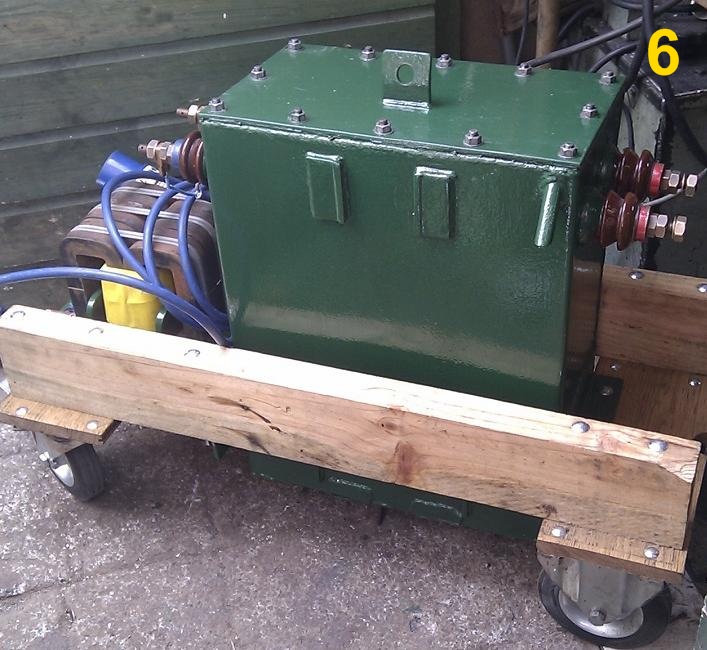
The trolley mounting allows it to be much more manoeuvrable for my long suffering wife and son to move around. The front of the case that bulged outwards and housed the two large 11kV input insulators has now been cut down. Originally the two small insulators on each side were the 250 volt outlets to the load. By using various combinations of these four terminals an input range of 10.45K to 11.55K could be accommodated.
As I would be wiring the transformer in reverse I used the 11.55K to 250 volt combination. When fed from a variac this gives me 12K out. This now left two terminals that were originally connected to the other two tapping points spare. I therefore altered the wiring inside and now use the spare pair as the 12K output.
The amount of oil is also now reduced but this will not present any problems for short term Tesla use.
Yes - I know the welding is atrocious.
After cutting some of the side away and bending the front panel upwards, we had a 0.125 inch gap where the two panels met, so we filled this gap with weld. Thankfully the result is oil tight which is the main objective.
Maybe the career change to working in a shipyard as a welder on submarines may have to be put on hold.
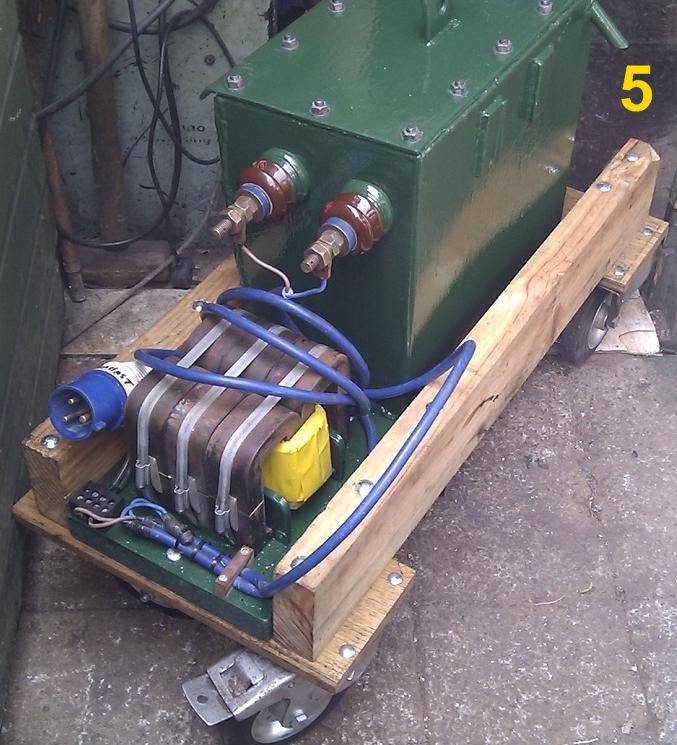
Low voltage (250v) on the left side, HV output on the right (marked red).
The remains of the two cradles that allowed the transformer to be pole mounted are still visible.
 |
 |
The homemade inductor I first used as ballast.
This was saturating with the distribution transformer as it was originally designed to work with my Homemade Transformer. I therefore decided to construct the variable ballast shown below.
 |

|
For the PDT's ballast I utilised the transformer from an old welder. With the welder's secondary short-circuited it gave me a variable range of inductance across its primary winding of 20m/H, variable up to 60 m/H
When this is placed in series with the primary feed of the pole distribution transformer (PDT) this gives an equivalent secondary side inductance for that transformer of 43H to 129H
This is because any inductance on the primary side is 'reflected' to the secondary side of a transformer. In doing so the value of the inductance on the primary side is multiplied by the transformer's turn ratio ^2 (squared).
Conversely a secondary inductance would appear smaller to the primary side and will equal the secondary side value divided by the turns ratio ^2.
|
 |
This case originally housed a 5H 2500v HV inductor and was oil filled. By turning the welder's core through 90 degrees so that the adjustment handle and its shaft now come out of the top, it made an ideal choice for my variable ballast. The case is once again oil filled allowing the entire core to be under oil to assist with cooling.
The ability to vary the inductance comes about because of a sliding lamination between the primary and secondary coils. This slide is attached to the threaded rod that projects out of the top of the case. |
A Replacement Ballast
As my power demands increased I found that the variable ballast also proved to be unsatisfactory, as the core was not really up to handling 6kW or more without overheating, despite the fact it was submerged in oil. I had found that a 3 minute continuous run could cause the exterior of the case to feel quiet warm, so goodness knows how hot the actual windings were. Another problem was that the undersized windings gave a resistance of 1.1 ohms, which with a current of 30 amps would mean a voltage drop of around 33 volts, this then becoming a 1500 volt drop on the secondary side of the transformer!
I therefore decided to build a heavy duty ballast and for this I chose to have a central core size of 12 sq inches. As the ballast would also have an air gap that would be packed with plastic, then there shouldn't be any chance of it saturating with my proposed 7.0 to 7.5kW load.
|
The Finished Ballast
|
|
The bare cores
Each pair of cores when joined measure approx' 6.5 x 3.8 inches by 2 inches deep. I have done some tests using some old wire, and I found that just 35 turns of 1.6mm would give 18mH around a 12 sq inch core. This shows that the permeability of the cores must be quiet high. This comes as no surprise as they were from a radar transformer and matching ballast, and therefore built to a high specification. For the actual ballast winding though I will be using thicker 3mm wire (AWG 9).
|
|
Above is how it will be constructed. Each 'pair' of cores has an area of 4 sq inches in the central section, giving a total of 12 sq inches for the three. Total number of cores used for the top and bottom is twelve - so it will be heavy!
|
|
The central wooden area of the former is the same size as the central area of the cores. The Tufnol 0.125 inch thick boards are placed around the central wooden core and will have the magnet wire wrapped around (see diagram above).
|
|
Once the coil is wound around the Tufnol boards, the two wood side sections are removed and the whole coil including the Tufnol boards, are slid off the central wooden former and placed in position over the cores.
|
|
My lathe centre height was not sufficient as standard, so some improvisation was needed. This is achieved by the lathe's own chuck driving an auxiliary one which is raised up above the bed.
I have successfully used this method in the past to wind both a six inch and my present eight inch coil.
I found the 3mm AWG 9 wire very stiff to wind around the wooden former.
I was in fact tensioning the wire by gripping it with both hands and hanging backwards as the lathe pulled against me. For this reason you need a very solid set-up for the winding jig.
I doubt a homemade coil winder that is free standing would cope with the forces unless it is bolted to something solid, so bear this in mind if you decide to wind something similar.
Also try to make the wooden former from a solid wooden block, and make sure that is well supported at its far end by a tailstock or something similar.
|
|
The chuck would not have sufficient grip by just holding the studding, so a steel peg was pushed into the wooden former and this is then driven around by the peg bearing against the chuck's jaw. (Outlined in red)
The use of the back gear on the lathe, combined with the variable frequency drive, will allow me a winding speed of 4 rpm.
|
Winding on the lathe
This was done using the lathe set up shown above.
|
|
|
Once the winding was completed the side pieces were removed.
The two side pieces were held in place by the threaded studding that
passed through the wooden former's centre and that the chuck was gripping. This clamped the two sides to the central block. The force of bending the thick wire would have easily pushed the sides outwards otherwise.
The nails you can see were just to stop the sides twisting on their axis, while the short metal stud on the left hand side, is the steel peg that bore against the chuck.
|
|
The wooden former is driven out.
The surface of the former had previously been smeared with grease before assembly, to allow the Tufnol sheets to slide off easily when the time came.
|
|
The cable straps are just temporary to stop the lower windings from slipping off the Tufnol former.
|
|
|
The plastic shims will be placed in here where the respective halves of each core meet
|
|
Once shimmed with 35 thou of plastic, I obtained 18.5mH from 64 turns of AWG 9 (3mm) wire.
Prior to the shimming I initially had 55mH from the 64 turns, when it was fully assembled.
|